
If you have ever spent a long day at a desk in New York or driven through heavy traffic in Los Angeles, you know that unmistakable "pull" in the back of your legs. Tight hamstrings are more than just a minor annoyance; they are often the silent culprit behind chronic lower back pain. Many of us try to ignore it, hoping a good night's sleep will fix the stiffness, but the body has a way of keeping score. When your hamstrings are tight, they pull on your pelvis, which in turn stresses the delicate structures of your lower spine.
The good news is that you don't need to be a flexible gymnast to find relief. Yoga offers a gentle, systematic approach to opening up these stubborn muscles while soothing the nervous system. By incorporating just a few targeted poses into your daily routine, you can begin to undo the damage of a sedentary lifestyle. In this guide, I will walk you through the connection between your legs and your back, and provide a roadmap of beginner-friendly poses that prioritize safety and long-term health.
Understanding the Hamstring-Back Connection

To fix a problem, we first need to understand it. Your hamstrings are a group of three muscles located along the back of your thighs. They run from the "sit bones" at the bottom of your pelvis down to just below your knees. Their primary job is to bend your knees and extend your hips. However, when we sit for hours at a time, these muscles remain in a shortened state. Over time, they lose their elasticity and become "stuck."
When you stand up with tight hamstrings, they act like a heavy anchor, pulling the back of the pelvis downward. This is called a "posterior pelvic tilt." This tilt flattens the natural curve of your lower back (the lumbar spine), putting immense pressure on the intervertebral discs. This is why many people who complain of back pain find that the pain actually originates from the tension in their legs. By stretching the hamstrings, we release the anchor, allowing the spine to return to its natural, pain-free alignment.
Why Modern Life is Tough on Your Posterior Chain
In the United States, the average adult spends over 6 hours a day sitting. Whether it's during a commute, at a workstation, or relaxing on the couch, our bodies are conditioned to be in a folded position. This lack of movement leads to "fascial adhesions," where the connective tissue around the muscles becomes tight and rigid. Yoga isn't just about stretching; it's about breaking up these adhesions and restoring blood flow to tissues that have been starved of oxygen and nutrients.
Top 5 Yoga Poses for Beginners
Below are five gentle poses specifically selected for those who are starting from zero. Remember, the goal is not to touch your toes today; the goal is to feel a sustainable, gentle stretch without any sharp pain.
| Pose Name | Primary Target | Difficulty Level |
|---|---|---|
| Cat-Cow Stretch | Spinal Mobility | Very Easy |
| Supta Padangusthasana | Hamstrings | Easy (with strap) |
| Child's Pose | Lower Back Decompression | Very Easy |
| Downward-Facing Dog | Full Posterior Chain | Moderate |
| Sphinx Pose | Lumbar Extension | Easy |
1. Cat-Cow (Marjaryasana-Bitilasana)
Before we target the legs, we must wake up the spine. Start on your hands and knees in a tabletop position. As you inhale (Cow), drop your belly toward the mat, lift your chest, and look up slightly. As you exhale (Cat), round your spine toward the ceiling, tuck your chin to your chest, and push away from the floor. This synchronized movement lubricates the spinal discs and prepares the nervous system for deeper stretching. Repeat this for 10 slow breaths.
2. Reclined Hand-to-Big-Toe Pose (Supta Padangusthasana)
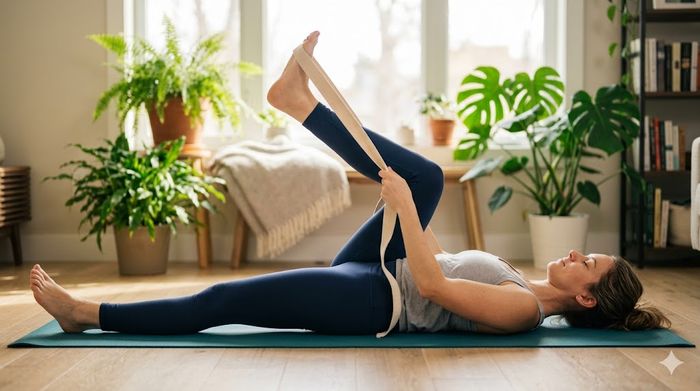
This is perhaps the safest way to stretch tight hamstrings because your back is supported by the floor. Lie on your back and loop a yoga strap (or a belt/towel) around the ball of your right foot. Extend your right leg toward the ceiling. Keep your left leg bent with the foot on the floor if your back feels sensitive, or straighten it for a deeper challenge. Hold for 1-2 minutes, breathing deeply into the tension, then switch sides.
3. Child’s Pose (Balasana)
If you feel pressure in your lower back, Child’s Pose is your best friend. From tabletop, bring your big toes together and push your hips back toward your heels. You can keep your knees together or spread them wide. Rest your forehead on the mat and reach your arms forward. This pose gently stretches the lower back muscles and allows the spine to decompress. It's a great "reset" button whenever you feel overwhelmed by the stretches.
4. Downward-Facing Dog (Adho Mukha Svanasana)
For beginners with tight hamstrings, the "secret" to Downward Dog is to keep your knees bent. From tabletop, tuck your toes and lift your hips toward the sky, forming an inverted "V" shape. Focus on pushing the floor away with your hands and lengthening your spine. By keeping your knees bent, you take the pressure off your lower back while still getting a significant stretch through the calves and upper hamstrings. Hold for 5-10 breaths.
5. Sphinx Pose (Salamba Bhujangasana)
Since tight hamstrings often lead to a rounded back, we need to gently introduce the opposite movement: extension. Lie on your stomach with your forearms on the mat, elbows directly under your shoulders. Press your pubic bone into the floor and lift your chest forward and up. Think about pulling your heart through your upper arms. This creates a gentle, therapeutic arch in the lower back without the intensity of a full Cobra pose.
Tips for a Safe Practice
Starting a yoga journey is exciting, but for those with existing back pain, caution is paramount. Here are three rules I always recommend to my beginner students:
- Never Bounce: Ballistic stretching (bouncing) can cause micro-tears in the muscles. Focus on slow, static holds instead.
- Breathe through the nose: Deep, nasal breathing activates the parasympathetic nervous system, which helps your muscles relax. If you're holding your breath, you're working too hard.
- Listen to "Bad" Pain: A "dull ache" or a "warm stretch" is normal. A "sharp stab," "numbness," or "tingling" is a sign to stop immediately.
Pro Tip: Use Props!
In the US, we often have a "no pain, no gain" mentality. In yoga, props like blocks and straps are not "cheating"; they are tools for alignment. If you can't reach the floor in a forward fold, bring the floor to you by using blocks. This keeps your back flat and prevents injury.
The Long-Term Benefits of Consistency
You won't fix years of sitting in a single session. However, within two weeks of consistent practice (just 15 minutes a day), most people report a significant reduction in morning stiffness. By the one-month mark, you may find that your posture has improved, and the nagging ache in your lower back has diminished. Beyond physical relief, the mental clarity that comes with mindful movement is a massive bonus in our high-stress world.
When you commit to this practice, you are essentially telling your body that its comfort matters. You are investing in your future mobility, ensuring that as you age, you can still play with your kids, enjoy long walks, and move through life with ease. It's not about being perfect; it's about being present and persistent.

The Verdict: Should You Start Today?
The short answer is: absolutely. Chronic back pain and tight hamstrings won't resolve themselves on their own. By choosing gentle, beginner-friendly yoga, you are choosing a sustainable path to health. These poses address the root cause of the tension rather than just masking the symptoms with medication. Whether you do it first thing in the morning to start your day fresh or before bed to unwind, your body will thank you.
For more health and wellness tips, feel free to explore our other guides at SorinBlogger. Remember, every master was once a beginner. Take that first step onto the mat today, and let the healing begin.
