
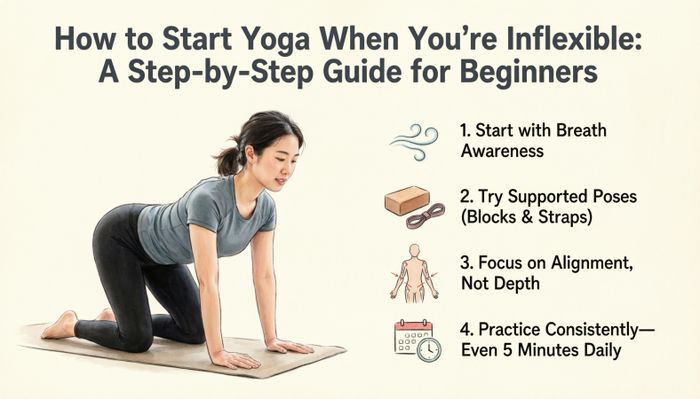
I hear it all the time: "I would love to try yoga, but I can barely touch my toes." If this sounds like you, I want you to know that you are not alone. In fact, thinking you need to be flexible to start yoga is like thinking you need to be in perfect shape to go to the gym, or that you need to be flawlessly clean before taking a shower. It simply does not make sense when you look at it logically. Flexibility is not a prerequisite for yoga; it is a result of it. When I first stepped onto a yoga mat, my hamstrings were so incredibly tight that simply sitting up straight on the floor felt like a monumental effort. I felt self-conscious, stiff, and out of place. But I quickly learned that the true essence of this practice has nothing to do with twisting yourself into a pretzel.

This guide is written specifically for those of us who sit at desks all day, who wake up with a stiff lower back, and who feel intimidated by the ultra-flexible instructors we see on social media. I am going to walk you through exactly how to begin your journey safely, effectively, and without a single ounce of judgment. Let us redefine what it means to practice, focusing entirely on how a pose feels in your unique body, rather than how it looks from the outside.
The Myth of the "Yoga Body"
Before we get into the physical movements, we must first address the mental roadblocks. Society has painted a picture of the "ideal" yoga body as someone who is naturally hyper-mobile, effortlessly flowing through advanced acrobatics. This image is incredibly misleading. The original texts of yoga barely mention physical postures (asanas) at all. The entire purpose of the physical practice was simply to open the body up enough so that a person could sit comfortably in meditation without being distracted by aches and pains.
If your muscles are tight, it means they are working exactly as they were designed to. They have adapted to your daily habits, such as sitting in a chair, driving a car, or looking down at a smartphone. Your body is smart and efficient. By starting yoga, you are simply teaching your nervous system new, healthier patterns. You do not need to "fix" your body; you just need to gently introduce it to new ranges of motion.
| Common Myth | The Reality |
|---|---|
| I need to touch my toes to do yoga. | Bending your knees is always allowed and encouraged to protect your lower back. |
| Yoga is only about stretching. | It is an equal balance of building functional strength, stability, and mobility. |
| If it doesn't hurt, it isn't working. | Pain is a warning sign. You should only feel a mild, manageable stretch. |
Why Being Inflexible is Actually an Advantage
This might sound completely counterintuitive, but being stiff and inflexible is actually a fantastic starting point. Hyper-mobile individuals (people who are naturally very flexible) often struggle to feel the boundaries of their muscles. Because they can easily drop into deep splits or extreme backbends, they frequently bypass their muscles entirely and hang into their joints and ligaments. Over time, this lack of structural support can lead to severe joint instability and chronic pain.
As a beginner with tight muscles, you have a built-in safety mechanism. Your body clearly tells you when to stop. You are much less likely to overstretch a ligament because your tight hamstrings or hips will hit the brakes long before you reach a dangerous range of motion. Furthermore, you will experience the benefits of the practice much faster. While a flexible person might need to work for an hour to feel a stretch, you will likely feel the deep, therapeutic benefits of a pose within the first few seconds. Celebrate your stiffness—it is keeping your joints safe.
Essential Props: Your Best Friends on the Mat
If there is one piece of advice I want you to remember from this entire guide, it is this: do not be afraid to use props. Props are not a sign of weakness or inexperience; they are intelligent tools that adapt the pose to your body, rather than forcing your body into the pose. They bring the floor closer to you, extend the reach of your arms, and provide much-needed support for tight joints.
- Yoga Blocks: These are absolutely non-negotiable for tight bodies. When you cannot reach the floor in a forward fold or a lunge, placing your hands on blocks elevates the ground. This prevents your spine from rounding uncomfortably and allows you to breathe deeply into the stretch. I recommend having at least two sturdy foam or cork blocks.
- Yoga Strap: A strap acts as an extension of your arms. If you are lying on your back and trying to stretch your leg up toward the ceiling, looping a strap around your foot allows you to keep your shoulders relaxed on the mat while still getting a highly effective hamstring stretch. If you do not have a dedicated yoga strap, a rolled-up towel, a belt, or even a dog leash works perfectly.
- A Thick Mat or Blanket: Tight hips and knees often come with sensitive joints. Using a well-cushioned mat, or keeping a folded blanket nearby to pad your knees during lunges, will make your practice infinitely more enjoyable. If you are in pain because your knee is grinding into a hard floor, you will not be able to focus on the actual stretch.
The Foundation: Mastering Your Breath
When we encounter physical resistance or tightness, our natural instinct is to hold our breath. This is a stress response initiated by the nervous system. When you hold your breath, your brain sends a signal to your muscles that you are in danger, causing them to contract and tighten even further to protect you. This makes stretching completely counterproductive.
To truly improve your mobility, you must learn to breathe deeply through the discomfort. I want you to practice diaphragmatic breathing. Inhale slowly and deeply through your nose, allowing your belly to expand outward like a balloon. As you exhale smoothly through your nose, allow the belly to naturally deflate. When you move into a stretch and feel tension, consciously slow down your exhale. A long, smooth exhale tells your nervous system that you are safe, which triggers your muscles to finally relax and lengthen.
Top 6 Poses for Inflexible Beginners
Now that we have covered the mindset, the props, and the breath, let us look at the actual movements. These six poses are foundational. I encourage you to try them slowly, heavily utilizing the modifications I have suggested below.
1. Mountain Pose (Tadasana)
It looks like you are just standing, but Mountain Pose is an active alignment exercise that improves posture. Stand with your feet hip-width apart. Press evenly into all four corners of your feet. Engage your thigh muscles gently, draw your belly button in slightly toward your spine, and roll your shoulders up, back, and down. Let your arms hang by your sides with your palms facing forward. Close your eyes and take five deep breaths here, feeling grounded and tall.
2. Cat-Cow Stretch (Marjaryasana-Bitilasana)
This is absolute magic for a stiff spine and lower back pain. Start on your hands and knees. If your knees hurt, place a blanket underneath them. As you inhale (Cow Pose), drop your belly toward the mat, lift your chest, and look forward. As you exhale (Cat Pose), press firmly into your hands, round your spine up toward the ceiling like a Halloween cat, and tuck your chin to your chest. Flow between these two shapes for ten rounds, syncing the movement entirely with your breath.
3. Downward-Facing Dog (Adho Mukha Svanasana) - Modified
Downward Dog is notorious for being frustrating for beginners. The secret is to bend your knees! From your hands and knees, tuck your toes and lift your hips up and back. If your hamstrings are tight, your back will round. To fix this, bend your knees deeply and focus entirely on pushing the floor away with your hands to make your spine as long and straight as possible. Your heels do not need to touch the floor—ever. Keep the knees bent and enjoy the stretch in your shoulders and back.
4. Standing Forward Fold (Uttanasana)
This pose is often where beginners feel the most defeated, but only because they lock their knees. From a standing position, hinge at your hips and fold forward. Bend your knees generously until your belly actually rests on your thighs. Let your head hang completely heavy. If your hands do not reach the floor, place them on two yoga blocks. Bending your knees protects your lower back and directs the stretch safely into the belly of the hamstring muscle.
5. Child’s Pose (Balasana)
This is your ultimate resting shape. From your hands and knees, bring your big toes to touch and widen your knees to the edges of your mat. Sink your hips back toward your heels and stretch your arms out long in front of you, resting your forehead on the mat. If your hips are too tight to reach your heels, or if your knees complain, place a rolled-up towel or a bolster between your calves and your thighs. Breathe deeply into your lower back.
6. Reclined Pigeon (Supta Kapotasana)
If you sit in a chair all day, your outer hips and glutes are likely incredibly tight. Lie on your back with both knees bent and feet flat on the floor. Cross your right ankle over your left thigh, just below the knee, making a figure-four shape. If you already feel a stretch, stay right here. If you need more, thread your hands behind your left thigh and gently pull the left leg toward your chest. Keep your right foot flexed to protect your knee. Switch sides after one minute.
| Pose Name | Best Modification for Tightness | Target Area |
|---|---|---|
| Forward Fold | Deeply bend knees, hands on blocks | Hamstrings & Lower Back |
| Downward Dog | Keep knees bent, focus on straight back | Shoulders & Calves |
| Child's Pose | Place a blanket between calves and thighs | Hips & Spine |
Building Consistency: How to Make it a Habit
The biggest mistake beginners make is trying to do too much too soon. Committing to a grueling 60-minute class every day will likely leave you sore, frustrated, and burnt out within a week. When it comes to improving mobility and flexibility, consistency is infinitely more important than intensity. Doing just ten to fifteen minutes of gentle movement every single day will yield drastically better results than doing one massive 90-minute session on the weekend.
I highly recommend starting with online classes specifically labeled "Yoga for Beginners" or "Yoga for Stiff People." There is a wealth of free content available where instructors cater specifically to modifications and alignment. Create a small, dedicated space in your home where your mat is always unrolled. When the barrier to entry is low—meaning your mat is already there waiting for you—you are much more likely to step onto it, even if just for five minutes before bed to do some Cat-Cow stretches.
Listening to Your Body: The Golden Rule
As you embark on this journey, you must learn the difference between "discomfort" and "pain." Discomfort is the sensation of a muscle gently lengthening. It might feel intense, but it is manageable, and you can breathe evenly through it. Pain, on the other hand, is sharp, sudden, or localized directly inside a joint (like your knee or shoulder). If you ever feel pain, you must back out of the pose immediately. There are no medals awarded for pushing through joint pain in yoga.
Always remember that your body changes from day to day. Some days you might feel relatively open and energetic, while other days you might feel as stiff as a board due to poor sleep, stress, or heavy workouts. Honor exactly where your body is on any given day. If you need to bend your knees deeper today than you did yesterday, that is perfectly fine. The practice is meant to serve you, not the other way around.

Verdict
Starting a yoga practice when you feel stiff and inflexible is truly one of the greatest gifts you can give to your future self. I want to reassure you that the initial awkwardness and tightness will fade with time and patience. By embracing your current physical boundaries, utilizing props like blocks and straps, and prioritizing deep, calming breaths over achieving perfect shapes, you unlock the true power of this ancient practice. Let go of the need to look like an acrobat. Focus on how your body feels, celebrate small victories of increased mobility, and remember that every expert was once a beginner who simply decided to unroll their mat and try. Your journey toward better health and a more comfortable body begins with just one deep breath.
