
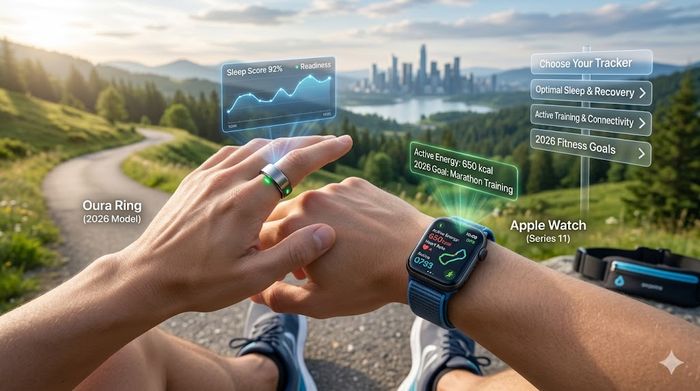
As we step into 2026, the landscape of wearable technology has shifted from mere step-counting gadgets to sophisticated health laboratories worn on our bodies. Choosing the right companion for your wellness journey has never been more personal or more complex. Whether you are training for a marathon, trying to optimize your sleep hygiene, or simply looking to manage daily stress, the debate often boils down to two titans of the industry: the discreet, data-heavy Oura Ring and the feature-rich, ultra-connected Apple Watch. Both have evolved significantly over the last few years, pushing the boundaries of what biometric sensors can do.
The Evolution of Health Wearables in 2026
In 2026, we are seeing a "sensor wars" era. The Apple Watch Series 11 has perfected its non-invasive health monitoring, while the Oura Ring Gen 4 has refined its form factor to be nearly indistinguishable from high-end jewelry. The choice between them isn't just about technical specs; it’s about how you want to interact with your data. One is a notification hub that keeps you connected to the world, while the other is a silent guardian that focuses purely on your internal rhythms.

Setting 2026 goals requires a tracker that aligns with your lifestyle. If your goal is to disconnect more and focus on mindfulness, the Oura's screen-free design might be your best bet. Conversely, if you need a digital assistant that coaches you through every bicep curl and sends you reminders to stay hydrated, the Apple Watch remains the gold standard.
Design and Comfort: Ring vs. Watch
The most immediate difference is how these devices feel on your body. The Oura Ring is designed for 24/7 wear. It is lightweight, made of titanium, and sits comfortably on your finger. In 2026, the Oura Ring has become even more ergonomic, with a thinner inner molding that houses its infrared sensors. It’s perfect for those who find wearing a watch to bed uncomfortable or who want to wear a traditional mechanical watch on their wrist while still tracking health data.
The Apple Watch Series 11, while sleek, is still a piece of "wrist real estate." It’s a statement piece. For fitness enthusiasts, the Ultra version provides rugged durability, but for the average user, the standard Series 11 offers a vibrant OLED screen that provides instant feedback. The trade-off is size; even the smallest Apple Watch is significantly more "present" than a ring.
| Feature | Oura Ring (2026) | Apple Watch S11 |
|---|---|---|
| Form Factor | Titanium Ring | Wristwatch |
| Screen | None (App only) | OLED Touchscreen |
| Interaction | Passive | Active/Touch/Voice |
| Weight | 4-6 grams | 32-50+ grams |
Sleep Tracking: The Gold Standard in 2026
If your 2026 health goal is to master your sleep, the Oura Ring remains difficult to beat. Because it measures heart rate and blood volume directly from the arteries in your finger, its data is often cited as more accurate for sleep stage detection than wrist-based sensors. The Oura app provides a "Sleep Score" that considers deep sleep, REM sleep, latency, and timing.
However, Apple has made massive strides. The Apple Watch Series 11 now features advanced sleep apnea detection and better battery management that makes overnight wearing more viable. Apple's "Sleep Stages" view in the Health app is beautiful and integrates with your iPhone’s "Sleep Mode" perfectly. The downside? You still have to find a time to charge the watch, whereas the Oura Ring can go nearly a week on a single charge.
Why Finger-Based Tracking Matters
The skin on your wrist is thicker, and the watch can shift during sleep, leading to "noisy" data. A ring fits snugly and maintains a consistent connection with the skin. For biohackers in 2026, the Oura's temperature tracking is its secret weapon, helping to predict illness and even track menstrual cycles with clinical-grade accuracy.
Activity and Fitness: Apple Watch’s Dominance
When it comes to active fitness tracking, the Apple Watch is the undisputed king. If you are a runner, swimmer, or gym-goer, the real-time feedback on your wrist is invaluable. You can see your heart rate zones, pace, and distance without breaking your stride. The Series 11 has also introduced "AI Coaching" which analyzes your form in real-time using the accelerometer and gyroscope.
Oura's approach to fitness is more "holistic." It doesn't want you to stare at a screen while you run. Instead, it records the activity in the background and tells you how it affected your "Readiness" for the next day. While Oura has improved its "Automatic Activity Detection," it’s still not a replacement for a dedicated sports watch. It’s more about the balance between strain and recovery.
The Integration Factor
Apple Watch integrates seamlessly with Apple Fitness+. In 2026, this ecosystem has expanded to include immersive AR workouts. If you enjoy gamifying your fitness through "Closing Rings" and competing with friends, Apple wins every time. Oura is more of a solitary, introspective tool.
Smart Features and Ecosystem
This is where the comparison becomes lopsided. The Apple Watch is a smartphone on your wrist. In 2026, with 6G capabilities and advanced Siri integration, you can reply to texts, make payments via Apple Pay, control your smart home, and even stream music directly to your AirPods. It is a tool for productivity as much as it is for health.
The Oura Ring has zero smart features in the traditional sense. It doesn't vibrate for calls; it doesn't show you the time. For many, this is its greatest strength. In a world of digital noise, the Oura is a sanctuary of silence. It collects data quietly and waits for you to check the app on your terms.
Battery Life and Maintenance
Battery life is the Achilles' heel of the Apple Watch. Even in 2026, with more efficient chips, the standard Series 11 usually requires a daily charge, or at best, every 36 hours. This creates "charging anxiety" and often leads to gaps in data when the watch is on the nightstand instead of the wrist.
The Oura Ring lasts 5 to 7 days. You can go on a weekend trip without even thinking about the charger. It’s a "set it and forget it" device. For long-term health tracking, consistency is key, and Oura’s battery life encourages that consistency.
Pricing and Subscriptions
In 2026, the financial commitment for both devices involves more than just the initial purchase.
- Oura Ring: Costs between $299 and $549 depending on the finish. However, to see your data, you must pay a monthly subscription fee (currently around $5.99). Without it, you only get basic scores.
- Apple Watch: Starts at $399 for the Series 11 and goes up significantly for the Ultra or stainless steel models. There is no mandatory subscription for health data, though Apple Fitness+ is a paid add-on.
Which One Should You Choose for Your 2026 Goals?
To make the best decision, you need to identify your primary health objective for the coming year.
Choose the Oura Ring if:
- Your main goal is sleep optimization and recovery.
- You want to "disconnect" from notifications and screens.
- You already wear a traditional watch or prefer a minimalist aesthetic.
- You want to track your health metrics 24/7 without worrying about charging.
Choose the Apple Watch if:
- You are an active athlete who needs real-time performance data.
- You want a multi-functional device that replaces your phone for quick tasks.
- You enjoy gamification, social competitions, and guided workouts.
- You don't mind the daily charging ritual in exchange for ultimate connectivity.

Verdict: The Best Tracker for 2026
Ultimately, the "best" tracker is the one you will actually wear. In 2026, the Oura Ring and Apple Watch are no longer direct competitors as much as they are lifestyle choices. For those seeking mindfulness and recovery, the Oura Ring is a whisper of wisdom on your finger. For those seeking maximum performance and productivity, the Apple Watch is a powerhouse on your wrist. Many enthusiasts have even started "double-tracking"—wearing the Oura for sleep and the Apple Watch for workouts—to get the best of both worlds. Whatever you choose, the data you collect today is the foundation for a healthier 2026.