
Flexibility is often misunderstood as a trait reserved for gymnasts, dancers, or people who have been stretching since childhood. In reality, flexibility is a fundamental component of overall human health, mobility, and physical longevity. Whether you spend eight hours a day hunched over a desk, doing manual labor, or simply managing the stresses of daily life in the United States, your muscles naturally contract and tighten. Over time, this chronic tightness can lead to poor posture, back pain, increased risk of injury, and a general feeling of physical restriction. The good news is that you do not need to dedicate hours to a yoga studio to reverse these effects. A targeted, well-structured 15-minute daily yoga routine can drastically transform your physical capabilities, release deeply held tension, and build lasting flexibility, even if you are an absolute beginner who can barely touch your toes.

Embarking on a journey to improve your mobility does not require expensive equipment or a massive time commitment. It requires consistency. By practicing for just a quarter of an hour every day, you train your nervous system to accept new ranges of motion. When you stretch, your nervous system's initial reaction is to resist—a protective mechanism to prevent muscle tearing. However, with gentle, consistent daily practice, your brain learns that these new physical extensions are safe. This neurological adaptation is the true secret to building sustainable flexibility. In this comprehensive guide, we will explore the ultimate beginner-friendly flow designed specifically to target the body's most notoriously tight areas: the hips, hamstrings, lower back, and shoulders.
Why 15 Minutes is the Magic Number for Beginners
When people decide they want to become more flexible, they often make the mistake of overcommitting. They might attend a grueling 90-minute advanced class, experience intense muscle soreness, and never return to the mat. The human body responds much better to frequent, mild stimulation than to infrequent, intense stress. Committing to a 15-minute window removes the psychological barrier of "not having enough time." It is entirely feasible to carve out 15 minutes before your morning coffee, during a lunch break, or right before bed to help calm your mind for sleep.
Furthermore, a short, focused session ensures that you maintain proper form. Fatigue is the enemy of good technique. By keeping the routine brief, you can stay mentally present and physically engaged, ensuring that every stretch is performed safely and effectively. Over the course of a week, those 15 daily minutes add up to over an hour and a half of dedicated flexibility work, yielding far superior results compared to a single, exhausting weekend session.
Preparing Your Space and Mindset
Before diving into the physical postures, it is crucial to set the stage for success. You do not need a perfect, minimalist studio, but you do need a space where you can extend your arms and legs without hitting furniture. Roll out a non-slip yoga mat. If you do not have a mat, a carpeted floor or a soft rug will suffice, though a mat provides better grip and cushioning for your joints. Wear comfortable, loose-fitting clothing that allows your body to move freely without restriction.
Your mindset is arguably more important than your physical space. Approach this routine with an attitude of curiosity rather than judgment. As a beginner, your body will likely feel stiff, and certain poses may feel awkward. This is completely normal and expected. The goal is not to force your body into a picture-perfect shape you saw on social media, but to find a mild, tolerable stretch where you can still breathe deeply. If you feel sharp pain, you have gone too far. If you feel a dull, manageable tension, you are in the optimal zone for growth.
The 15-Minute Daily Yoga Routine: Step-by-Step
This sequence is designed to warm up the spine, gently open the hips, and gradually stretch the hamstrings and shoulders. Move through these poses slowly, allowing your breath to guide your transitions. Remember to breathe deeply in through your nose and out through your mouth or nose, expanding your diaphragm with every inhalation.
1. Child’s Pose (Balasana) - 2 Minutes
Start by kneeling on your mat. Bring your big toes together to touch and widen your knees apart to about the width of your mat. Slowly sit your hips back toward your heels and walk your hands forward until your forehead rests gently on the floor. If your forehead does not easily reach the floor, place a folded blanket or a yoga block underneath it. Child's Pose is a foundational resting posture that gently elongates the lower back, opens the hips, and stretches the lats (the muscles along the sides of your back). Spend two full minutes here, focusing on sending your breath into your lower back, feeling it expand like a balloon with every inhale.
2. Cat-Cow Stretch (Marjaryasana-Bitilasana) - 2 Minutes
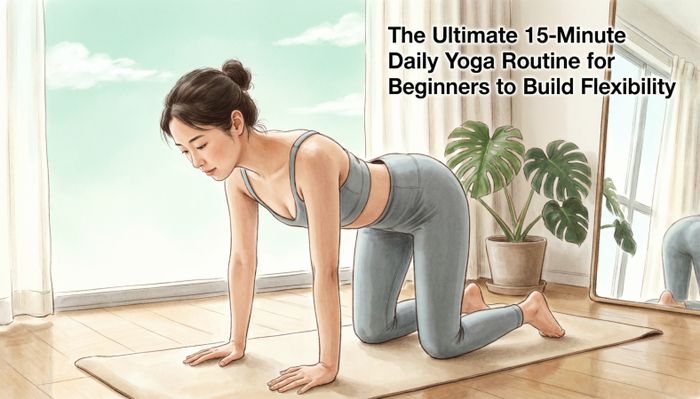
From Child's Pose, press up onto all fours into a tabletop position. Ensure your wrists are directly under your shoulders and your knees are directly under your hips. Keep your spine neutral. As you inhale, drop your belly towards the floor, lift your chest, and gaze slightly upward (Cow Pose). As you exhale, press firmly into your hands, round your spine toward the ceiling, and tuck your chin to your chest (Cat Pose). Continue flowing smoothly between these two shapes for two minutes. This dynamic movement warms up the synovial fluid in your spinal column, deeply massaging the spine and releasing tension trapped in the upper back and neck.
3. Downward-Facing Dog (Adho Mukha Svanasana) - 2 Minutes
From tabletop, tuck your toes under, spread your fingers wide, and lift your hips up and back. Your body should form an inverted "V" shape. As a beginner, it is vital to keep a generous bend in your knees. The primary goal of Downward Dog is a long, straight spine, not perfectly straight legs. Press the floor away from you, wrapping your triceps downward to broaden your upper back. Slowly begin to "pedal" your feet by bending one knee deeply while pressing the opposite heel closer to the floor. This provides a deep, targeted stretch to your calves and hamstrings. Hold and breathe for two minutes, taking breaks in Child's Pose if your arms become too tired.
4. Standing Forward Fold (Uttanasana) - 2 Minutes
Slowly walk your hands back toward your feet, or walk your feet forward to your hands. Keep your feet hip-width apart and let your upper body hang completely heavy over your legs. Again, bend your knees as much as you need to so that your belly rests comfortably on your thighs. Let your head and neck relax entirely; you should be able to shake your head "yes" and "no" freely. You can grab opposite elbows with your hands, creating a frame around your head. This posture decompresses the spine using gravity while providing a safe, intense stretch to the entire backline of the body, from the soles of your feet up through your hamstrings and lower back.
5. Low Lunge (Anjaneyasana) - 2 Minutes (1 Minute per leg)
From your forward fold, place your hands on the mat and step your right foot far back. Gently lower your right knee to the floor. Ensure your left knee is tracking directly over your left ankle, not pushing past your toes. Lift your chest and rest your hands on your left thigh, or sweep them up toward the ceiling if you feel balanced. You should feel a deep stretch in the front of your right hip (the hip flexors). Hip flexors become notoriously tight from prolonged sitting, pulling on the lower back and causing discomfort. Breathe deeply into the stretch for one minute, then slowly switch sides, stepping the right foot forward and the left foot back.
6. Seated Forward Bend (Paschimottanasana) - 2 Minutes
Make your way down to a seated position with your legs extended straight out in front of you. Sit up tall, imagining a string pulling the crown of your head toward the ceiling. As you inhale, reach your arms up. As you exhale, hinge from your hips (not your waist) and reach toward your shins, ankles, or feet. Do not force yourself to touch your toes; simply rest your hands wherever they naturally fall. To keep your spine straight, it is perfectly acceptable to maintain a slight bend in your knees. This pose provides a profound stretch for the entire back of the body and encourages a state of mental introspection and calm.
7. Corpse Pose (Savasana) - 3 Minutes
Finally, lie flat on your back. Let your legs separate naturally and allow your feet to flop open. Rest your arms by your sides with your palms facing up to open the chest. Close your eyes and allow your breathing to return to its natural, unforced rhythm. While it looks like you are doing nothing, Savasana is a critical component of the practice. It is the time when your nervous system integrates the physical changes and stretches you just performed. Spend the final three minutes of your routine completely surrendering to gravity, letting go of any residual muscular tension.
Quick Reference Guide to the Routine
| Pose Name (English/Sanskrit) | Duration | Primary Target Area | Beginner Modification |
|---|---|---|---|
| Child's Pose (Balasana) | 2 Minutes | Lower Back, Hips | Place blanket under forehead |
| Cat-Cow (Marjaryasana-Bitilasana) | 2 Minutes | Spine Mobility, Neck | Pad knees with a towel |
| Downward Dog (Adho Mukha Svanasana) | 2 Minutes | Hamstrings, Calves, Shoulders | Keep a deep bend in both knees |
| Standing Forward Fold (Uttanasana) | 2 Minutes | Spine, Hamstrings | Rest hands on yoga blocks |
| Low Lunge (Anjaneyasana) | 2 Mins (1/leg) | Hip Flexors, Quads | Keep hands on the floor for balance |
| Seated Forward Bend (Paschimottanasana) | 2 Minutes | Full Backline of Body | Use a strap around the feet |
| Corpse Pose (Savasana) | 3 Minutes | Central Nervous System | Place bolster under knees for lower back support |
The Importance of Breath in Stretching
You cannot force your muscles into flexibility by simply pulling on them; you must convince your brain that the stretched position is safe. This is where your breath plays a paramount role. When we experience physical discomfort or challenging stretches, our instinct is to hold our breath. Holding your breath sends a panic signal to your brain, triggering the "fight or flight" response. This causes your muscles to contract and tighten further—the exact opposite of what you want to achieve.
Instead, practice deep, diaphragmatic breathing throughout this 15-minute routine. Focus on making your exhalations slightly longer than your inhalations. Long exhales stimulate the vagus nerve, which activates the parasympathetic nervous system (the "rest and digest" state). When your nervous system is calm, it commands your muscles to relax and release, allowing you to sink deeper into the posture naturally and safely without forcing the movement.
Common Mistakes to Avoid
As a beginner building a daily habit, avoiding injuries and setbacks is your highest priority. Here are a few common pitfalls to watch out for as you establish your new yoga routine:
- Bouncing: Never bounce in a stretch (known as ballistic stretching). This can cause micro-tears in the muscle fibers. Instead, enter the stretch slowly and hold it statically.
- Comparing Yourself to Others: Yoga is a highly individual practice. Your bone structure, muscle history, and daily habits dictate your flexibility. Focus solely on how the stretch feels in your own body, not on what it looks like from the outside.
- Locking the Joints: Avoid hyperextending your knees or elbows. Keep a micro-bend in the joints to ensure the surrounding muscles are doing the work, rather than putting stress on the ligaments.
- Ignoring Pain: Discomfort is normal when stretching tight muscles; sharp, stabbing, or shooting pain is a warning sign. Always back out of a pose if you experience actual pain.
Tracking Your Flexibility Progress
Changes in flexibility happen gradually, often so subtly that you might not notice them from day to day. To stay motivated, it helps to track your progress objectively. Take a photograph of yourself in the Standing Forward Fold on day one, and then take another photograph in the same pose every two weeks. You will likely be amazed to see how your body slowly opens up, allowing your hands to inch closer to the floor over time. Beyond physical markers, pay attention to how your body feels during everyday activities. You might notice that bending down to tie your shoes feels easier, or that your lower back does not ache as much after a long commute.

Verdict: Consistency Is Your Best Asset
Building flexibility does not require you to turn your life upside down. By dedicating just 15 minutes a day to this beginner-friendly yoga routine, you are investing in your body's long-term health and mobility. Remember to listen to your body, prioritize deep breathing over deep stretching, and celebrate the small, incremental improvements. Your body is highly adaptable, and with patience and daily practice, you will inevitably see and feel profound changes in your flexibility and overall well-being. Unroll your mat today and take the first step toward a more mobile, pain-free life.
